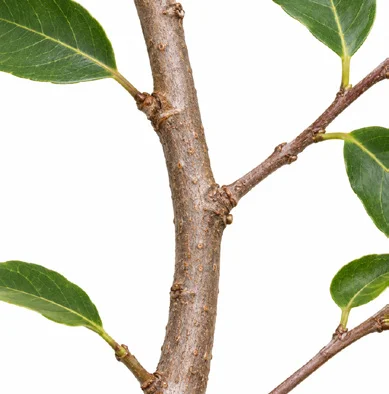
Bark
Stem woody, greyish-brown, generally smooth when young and becoming rough with age; young branches greenish to brown.


Syn. Salacia prinoides
Stem woody, greyish-brown, generally smooth when young and becoming rough with age; young branches greenish to brown.
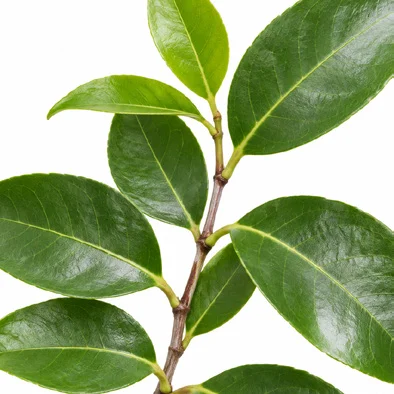
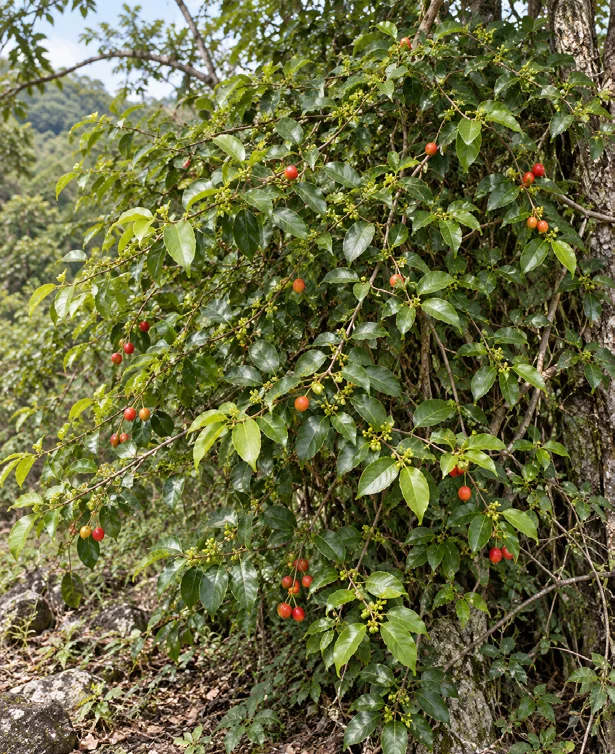
Branchlets are angular, with leaves carried on stalks 8-10 mm long. Leaf blade is elliptic, narrowly ovate-round or obovate-elliptic, 5-11 X 2-5 cm, leathery, base wedge-shaped, margin sparsely toothed, tip nearly acute.
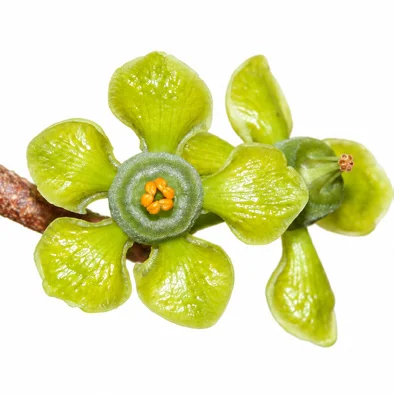
Small yellow-green flowers arise in 3-6-flowered fascicles in leaf axils. Flower stalks are 6-10 mm. Sepals are triangular, up to 1 mm. Petals are broadly ovate, 3 mm, broadly spreading or curved outward, with rounded tip. Disk is cup-shaped, 1 mm tall.
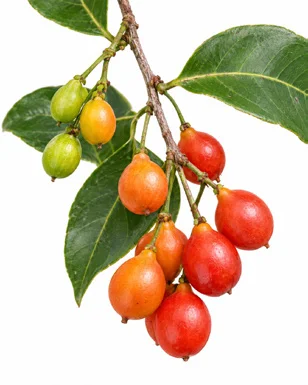
Berry is round or ovate, 1 cm in diameter, red when ripe, 1-seeded.
It is traditionally known as Saptarangi, meaning “seven colours.” The name refers to the distinctive, contrasting bands of colour sometimes visible in the wood when the stem or root is cut across.

China (Guangxi, Guangdong) to Tropical Asia and N. Australia